

Last Updated: 27th March 2023
New this year with all my race previews will be a Strength of Start List %. This will feature in both short and long course race previews. Here is how it is calculated.
How is the % calculated?
I take the top 25 ranked athletes in a start list to calculate the overall strength. This feels like a large enough sample to ensure that depth plays a factor but small enough that there is a focus on the top athletes in the race.
The rankings used for short course races will be the World Triathlon Rankings as these run all year rather than the WTCS rankings. For long course racing the PTO rankings will be used.
The top 25 ranked athletes on the start list will be given an inverse ranking of 101 – athlete ranking. So #1 ranked athlete will be given 100, #2 99 and so on. Any athletes ranking below 100 receive a score of zero.
These inverse rankings are summed for the top 25 athletes on the start list and divided by the maximum possible sum. If the current top 25 ranked athletes were all racing in one race then the sum of the inverse rankings would be 2,200. Therefore we can take the sum of the top 25 ranked athletes on the start list and divide by 2,200 to get the strength of start list %.
Example
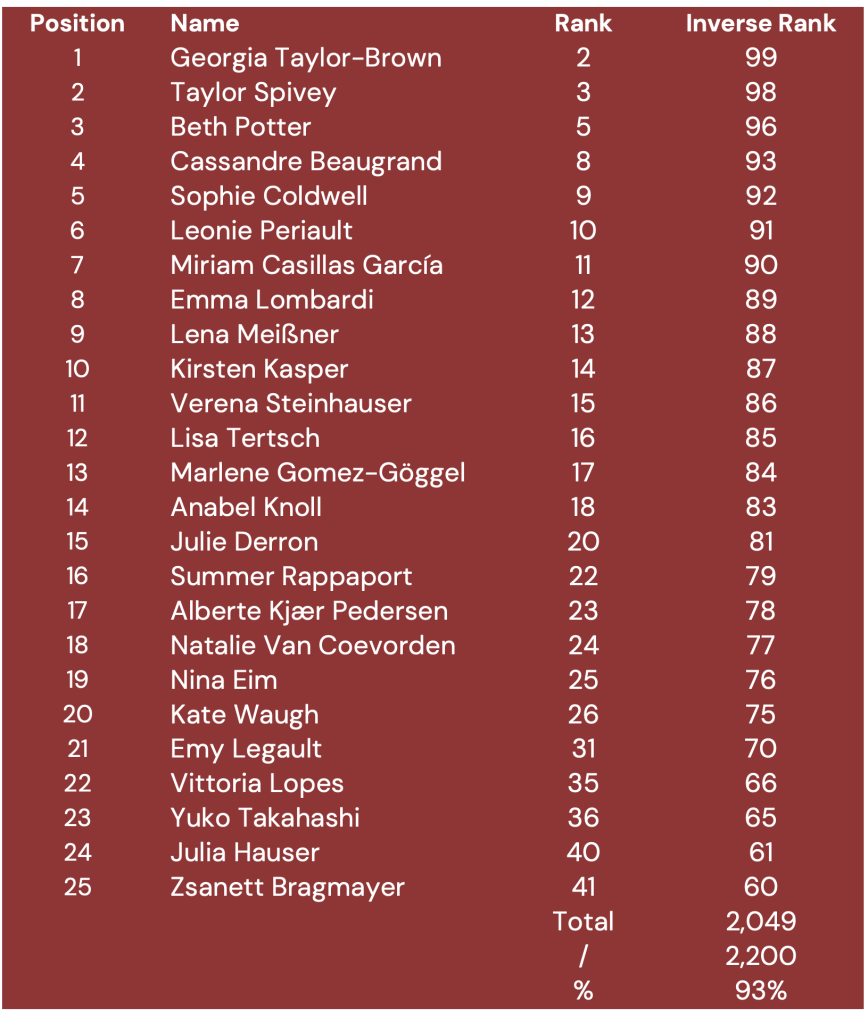
Here is an example of the ranking for the women’s WTCS Abu Dhabi race in March 2023. This race gets a 93% strength rating. The rating falls as only 6 of the top 10 ranked athletes are racing.
What does the % tell you about the field?
You can refer to the below table to see what a comparable percentage is. This table looks at the score of having different levels of the top ranked athletes in the field. For example if the top 15 ranked athletes race and no other athletes are in the field then the start list percentage is 63%. If the bottom 15 athletes in the top 100 rankings are the only athletes racing then the percentage is 5%.

Other Notes
If short course athletes feature on a long course start list and they do not have a PTO ranking or have not raced enough times for that ranking to reflect their strength, then their short course ranking with be used but an 85% factor will be applied to it. For example, if Leo Bergere enters a long course race this will apply as he doesn’t have a PTO ranking. We use his short course ranking, #1, which inversed is 100. The 85% factor is applied, so we would use 85 in the calculation.
For start list smaller than 25 the sum of the inverse rankings will still be divided by 2200. This is so the depth of the field is factored into the ranking.
 Triathlon Insights
Leave a comment